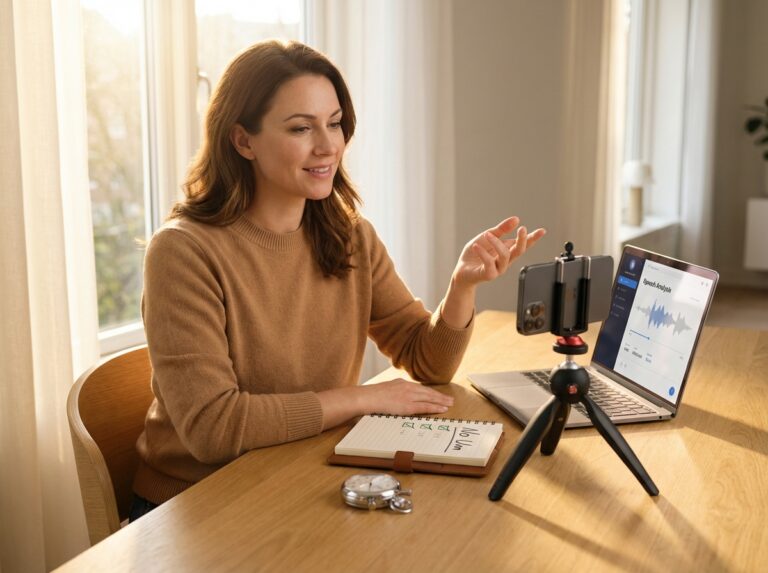
Mastering a clear, confident 30-second elevator pitch starts with speech clarity. This article guides adults in the U.S. through structured at-home articulation drills, pronunciation tips, breathing and voice techniques, and a practical daily practice plan. Learn how to craft and deliver a concise value statement, measure progress, and build speaking confidence for everyday conversations and professional encounters.
Why clear speech matters and how the 30 second pitch fits
Your voice is one of the most powerful tools you own. How you use it directly shapes how others perceive you, from a casual conversation to a high-stakes job interview. Speech clarity isn’t just about being understood; it’s a fundamental skill that builds rapport, establishes credibility, and opens doors. Studies show that clear articulation can increase your perceived competence by as much as 27% in professional settings. When listeners don’t have to struggle to decipher your words, they can focus entirely on your message. This seamless communication builds trust and makes people feel more connected to you, with rapport building up to 2.5 times faster with speakers who are easy to understand. In a competitive environment, clear, confident speech can be the deciding factor that sets you apart.
This is where the 30-second elevator pitch becomes essential. It’s more than just a quick summary of what you do. It is a focused, value-oriented statement designed to capture attention and communicate your worth instantly. But a brilliant message delivered poorly is a brilliant message lost. Clarity is the amplifier that ensures your pitch lands with maximum impact. Every mumbled word, rushed phrase, or hesitant sound diminishes its power. When your articulation is crisp and your delivery is confident, your value proposition becomes undeniable. You are not just telling someone what you do; you are showing them your professionalism and competence through the very act of speaking.
The need for this skill has become even more critical in our current environment. With a significant portion of U.S. jobs now operating on a hybrid or remote model, much of our communication happens through a microphone, where audio compression can strip away nuance and make unclear speech even harder to follow. The window to capture attention in a virtual meeting has shrunk significantly. You no longer have the luxury of a slow wind-up. Your first words must be sharp and compelling. We also live in a world of voice-first interfaces. A significant number of U.S. adults now use devices like Alexa or Siri daily, a technology that rewards precise articulation and punishes ambiguity. These trends highlight a simple truth; concise, clear speech is no longer a soft skill, but a core professional competency. For more on this, you can explore The Future of Speech Analytics: Trends to Watch in 2025.
Consider the difference in these two pitches.
Example 1 (Poor Clarity)
“So, uh, I’m in, like, project management… I help teams, you know, get stuff done. We use a bunch of different software tools to kinda keep track of things and make sure we’re on schedule, I guess.”
This pitch is vague, filled with fillers, and lacks confidence. The listener is left with a fuzzy idea and an impression of uncertainty.
Example 2 (Clear Clarity)
“I’m a project manager who streamlines complex workflows. I implement agile software solutions that increase team productivity by 20%, ensuring projects are delivered on time and under budget.”
This version is direct, specific, and value-driven. The crisp articulation and confident tone make the message powerful and memorable.
Investing in your speech clarity yields tangible results.
- Fewer Misunderstandings. Clear communication reduces errors and the need for constant clarification, saving time and preventing frustration in both personal and professional contexts.
- Higher Listener Engagement. When you speak clearly and with vocal variety, people are more likely to stay tuned in. Studies show engagement can increase by as much as 35% when a speaker’s delivery is dynamic and easy to follow.
- Stronger First Impressions. A first impression is formed in seconds, and your voice is a huge part of that. A clear, steady voice conveys confidence and authority, making you instantly more credible.
- Improved Networking Results. A concise, well-delivered pitch can lead to 62% better connection rates at networking events. People are drawn to those who can articulate their value clearly and confidently.
This level of clarity isn’t accidental; it’s a physical skill built on a foundation of breath, posture, and precise articulation. The following sections will provide the practical drills to build that foundation from the ground up.
Essential articulation breathing and voice techniques to practice at home
Before you can deliver a crisp 30-second pitch, you need to build the physical foundation that makes clear speech possible. Think of your voice like an instrument. It requires proper posture, breath support, and fine-tuned muscles to produce a clear, resonant sound. These at-home exercises are designed to build that foundation from the ground up, giving you control and confidence over how you sound.
Posture and Breath: The Engine of Your Voice
Your power to speak clearly starts with how you stand and breathe. Slouching constricts your airway and limits your lung capacity, resulting in a weak, muffled voice. Proper breathing provides the steady stream of air needed to support your words through an entire phrase, eliminating the need to rush or trail off at the end of a sentence.
- Posture: Stand with your feet shoulder-width apart, spine straight, and shoulders relaxed and down. Keep your chin parallel to the floor. This alignment opens your chest and allows your diaphragm to move freely. It can significantly improve vocal projection.
- Diaphragmatic Breathing: This is breathing from your belly, not your chest. Place one hand on your stomach and the other on your chest. Inhale slowly through your nose, focusing on making your stomach expand while your chest remains relatively still. Exhale slowly through your mouth. This technique gives you a deeper, more stable reservoir of air, allowing you to speak in longer, smoother phrases of 15-20 words without gasping for breath.
Relaxation and Resonance: Shaping the Sound
Tension is the enemy of clarity. A tight jaw, stiff lips, or a tense tongue will garble your words. Learning to relax these articulators is crucial. Resonance is about using the natural amplifying spaces in your head (your nasal and sinus cavities) to give your voice richness and carrying power, so you don’t have to shout to be heard.
- Jaw and Lip Relaxation: Tension here makes sounds like /b/, /p/, and /m/ difficult to form. Gently massage your jaw muscles in a circular motion. Let your jaw hang slack and gently shake your head from side to side.
- Tongue Placement: Precise articulation depends on where your tongue is in your mouth. For example, crisp /t/, /d/, and /n/ sounds require the tip of your tongue to tap the ridge just behind your top front teeth. Awareness of this placement can help reduce lisping tendencies.
Practical Daily Warmups (5 Minutes)
Start every practice session with these exercises to prepare your voice and articulators.
- 4-4-8 Breath Control: Inhale through your nose for a count of 4, hold the breath for a count of 4, and exhale slowly through your mouth for a count of 8. Repeat 5 times to calm your nervous system and focus on your breath.
- Lip Trills: Vibrate your lips together to make a “motorboat” sound. This relaxes the lips and face while engaging breath support. Do 3 sets, holding the trill for 10-15 seconds each.
- Straw Phonation: Hum into a straw, either in the air or into a glass of water. This simple exercise, practiced for 5 minutes daily, helps balance airflow and vocal cord vibration, reducing vocal strain.
- Humming: Hum a gentle /m/ sound on a comfortable pitch. Feel the vibration on your lips and around your nose. This helps you find your natural resonance. Do this for 2 minutes.
Articulation Drills for Precision
These drills train your muscles to move accurately and efficiently.
- Sustained Vowels: Take a deep diaphragmatic breath and produce a steady “ah” sound for as long as you can without straining. The goal is a consistent tone and volume, not a loud one. Time yourself and aim for gradual improvement. Do this for 2 minutes daily.
- Minimal Pair Drills: Practice words that differ by a single sound to fine-tune your ear and tongue. Focus on common confusions like /r/ vs. /l/ (right/light), /s/ vs. /ʃ/ (sip/ship), or /i/ vs. /ɪ/ (leave/live). Say each pair slowly and deliberately. Complete 5 sets of 10 different pairs.
- Tongue Twisters: The goal is precision, not speed. Choose a twister like “She sells seashells by the seashore” and say it slowly, exaggerating each consonant sound. Ensure every sound is distinct. Perform 3 sets of 10 slow, careful repetitions.
Safe Voice Use and Objective Feedback
Your voice is not invincible. With about 23 million Americans suffering from voice problems at any given time, proper care is essential. Stay hydrated by drinking at least 64 ounces of water daily. If your voice feels tired or hoarse after practice, take a 15-minute vocal nap—complete silence. To track your progress objectively, use simple tools. A smartphone recorder is your best friend; listen back to your pitch recordings to catch filler words, rushed pacing, and mumbled sounds. Use a free metronome app set to 120-140 beats per minute to practice speaking at a clear, controlled pace. Finally, pitch and loudness meter apps can give you visual feedback, helping you practice varying your pitch for engagement and maintaining a consistent conversational volume.
A structured at home practice plan including a 30 second elevator pitch routine
Consistency is the engine of progress. The following 8-week plan is designed to fit into a busy schedule, requiring just 15 to 30 minutes a day to build the muscle memory for clear, confident speech. The goal is not perfection overnight but steady, noticeable improvement week by week.
An 8-Week Progressive At-Home Plan
Weeks 1–2: Foundation and Awareness.
Focus on mastering the basic mechanics from the previous chapter. The goal is deliberate, slow, and accurate production of sounds. Your daily practice will be around 15 minutes.
Weeks 3–4: Building Fluency and Pitch Crafting.
You will increase the complexity of drills and begin scripting your elevator pitch. Practice time extends to about 20–25 minutes daily as you start connecting sounds into smooth phrases.
Weeks 5–6: Refining and Automating.
The focus shifts to making clear speech your default. You will work on reducing your reliance on notes and improving the natural flow of your pitch. Daily practice is about 25 minutes.
Weeks 7–8: Pressure-Proofing and Real-World Application.
Here, you will simulate real-life scenarios to build confidence under pressure. The goal is to transition your practiced skills into spontaneous conversation. Practice time is 20–30 minutes.
Your Daily 15–30 Minute Routine
Commit to this structure every day for the best results. Use a timer to stay on track.
- Warmup (5 minutes). Start with the exercises from the previous chapter. Perform 2 minutes of diaphragmatic breathing (4-4-8 count), followed by 3 minutes of lip trills, humming, and jaw release stretches. This prepares your vocal instrument.
- Articulation and Pronunciation Drills (8–12 minutes). Work on specific sounds. Spend 5 minutes on tongue twisters, saying them slowly at first and gradually increasing speed. Use the next 5–7 minutes for minimal pair drills, focusing on sounds you find challenging, like /r/ vs. /l/ or /s/ vs. /θ/.
- Elevator Pitch Practice (5–8 minutes). This is where you apply the skills. Use the techniques described below to rehearse your 30-second pitch.
- Reflection and Recording Review (2–5 minutes). Use your smartphone to record your pitch practice every day. Listen back immediately. Note one thing that went well and one thing to improve tomorrow. Did you mumble? Rush? Forget to breathe? This feedback loop is critical.
The 30-Second Elevator Pitch Template
A powerful pitch is a structured story. Aim for a speech rate of around 130–150 words per minute, which means your 30-second pitch will be about 65–75 words. Use this framework.
- The Hook (5–8 seconds, 12–20 words). Start with who you are and the core problem you solve or the primary value you offer. Make it compelling.
- The Value Statement (10–12 seconds, 25–30 words). Explain how you deliver that value. What is your unique process, skill, or method?
- Evidence or Example (5–7 seconds, 12–18 words). Provide a concrete, quantifiable result or a brief example that proves your value statement.
- The Call to Action (3–5 seconds, 8–12 words). End with a clear, simple question or statement that tells the listener what to do next.
Scripting Examples
For Job Networking:
(Hook) Hi, I'm Alex Rivera. I specialize in turning raw data into actionable sales strategies that boost revenue.
(Value) I use predictive analytics and machine learning models to identify untapped customer segments and optimize marketing spend for maximum impact.
(Evidence) In my last role, my team increased qualified leads by 35% in just six months.
(Call to Action) I'd be interested to hear about the data challenges your team is facing.
For Introducing a Small Business:
(Hook) I'm Jamie, the founder of Urban Roots. We make it easy for city dwellers to grow their own organic food.
(Value) We provide compact, self-watering vertical garden kits designed for small balconies and indoor spaces, complete with soil and seeds.
(Evidence) Last year, we helped over 500 families in this city harvest their own fresh produce.
(Call to Action) You can scan this code to see which kit fits your space.
For Summarizing a Project:
(Hook) I'm leading the Project Nightingale upgrade, which is designed to reduce our system's patient data errors by 50%.
(Value) We are implementing a new validation layer and a streamlined user interface to simplify data entry for our clinical staff.
(Evidence) Our beta test with the oncology department showed a 98% accuracy rate.
(Call to Action) I'm looking for feedback on the new interface from your team next week.
Iterative Practice Techniques
Simply reading your pitch aloud is not enough. Use these methods to internalize it.
- Chunking. Break your pitch into its four parts. Master each chunk separately before linking them together. Practice just the hook until it feels effortless, then move to the value statement.
- Slowed Speech. Practice your entire pitch at half your normal speed (around 80 words per minute). This forces you to over-articulate every sound and solidifies muscle memory.
- Shadowing. Find a 30-second clip of a speaker you admire, perhaps from a TED Talk. Play the clip and try to speak along with them, matching their pace, pitch, and intonation exactly. Do this five times in a row.
- Progressive Reduction of Notes. Start by reading your pitch from a full script. Then, reduce it to bullet points. Next, practice with just three keywords. Finally, practice with no notes at all.
Tracking Your Progress
To stay motivated, you need to see results. Track these four metrics weekly.
| Metric | How to Track | Weekly Goal |
|---|---|---|
| Speech Rate (WPM) | Time your pitch. Divide the total word count by the time in seconds, then multiply by 60. | Achieve and maintain 130–150 WPM. |
| Percent Intelligibility | Ask a friend or family member to listen to your recorded pitch and write down what they heard. Compare it to your script. | Reach 95% intelligibility by Week 8. |
| Self-Rated Clarity | On a scale of 1 (mumbled) to 10 (crystal clear), rate your own clarity after each recording. | Increase your average score by 1 point every two weeks. |
| Pitch Rehearsals | Keep a simple tally of how many times you practiced your pitch each day. | Complete at least 50 rehearsals per week. |
From Solo Practice to Real Conversation
In the final weeks, it’s time to simulate pressure. Practice your pitch in front of a mirror while a one-minute timer counts down. The added visual and time pressure helps mimic real-world nerves. Next, transition to conversational use. Plan to use your pitch in low-stakes situations, like on a video call with a friend or when introducing yourself in a casual online group. The goal is to deliver it not as a memorized script, but as a natural, confident part of your conversation. This transition is the final step in making clear, impactful speech an integral part of who you are.
Frequently Asked Questions about adult clear speech training
Embarking on a journey to improve your speech can bring up a lot of questions. It’s completely normal to wonder about the process, the timeline, and what to do if you hit a roadblock. Here are answers to some of the most common questions that come up when adults start clear speech training at home.
How long before I notice improvement?
You can expect to feel a difference in your control and awareness within the first two weeks of consistent, daily practice. Your mouth, tongue, and jaw will start to feel more agile. Others will likely start to notice a change in your clarity within three to four weeks. Significant, lasting improvement, where clear speech becomes your default, typically takes about eight weeks of dedicated effort. Remember, the goal is to build new muscle memory, which takes time and repetition.
- Realistic Expectation
Aim for small, incremental gains. Following the 8-week plan outlined previously, you should see your self-rated clarity score improve by at least one point every two weeks. - Troubleshooting
If you feel stuck after a month, review your practice recordings. Are you rushing through drills? Are you truly focusing on the target sounds? Go back to basics and slow down your pace by 50% for a few days. - Quick Check
Record yourself reading the first paragraph of a news article today. Don’t try to be perfect. Save it. In two weeks, record the same paragraph again. Listen to both recordings back-to-back. You will hear the difference.
Can accent reduction be done at home?
Yes, absolutely. The goal isn’t to eliminate your accent, which is part of your identity, but to modify specific sounds that may be hindering clarity for your listeners. This process, often called accent modification, is very achievable at home. Success comes from targeted, repetitive practice of the specific phonemes, rhythms, and intonation patterns of your target language.
- Realistic Expectation
Focus on one or two challenging sounds at a time, like the difference between /l/ and /r/ or the ‘th’ sound. It can take four to six weeks of dedicated drills to master a new vowel sound and make it habitual. - Recommended Alternatives
Apps like ELSA Speak and BoldVoice provide AI-driven feedback on pronunciation. Finding a language exchange partner for weekly calls can also provide real-world practice. - Quick Check
Identify one word you know is challenging for you. Say it slowly five times, paying close attention to the shape of your mouth and the position of your tongue using a mirror. Now, say it in a short sentence. This micro-focus builds awareness.
What if I have a speech disorder or stutter?
The exercises in this guide, like breathing techniques and articulation drills, can be beneficial for improving overall muscle control and confidence. However, they are not a substitute for professional therapy. A speech disorder or stutter requires a tailored approach from a qualified professional. Self-practice can support therapy but should not replace it.
- Realistic Expectation
While home drills may help reduce the frequency of mild disfluencies, they may not address the core issues. If you see no improvement in four weeks, it is a strong indicator that you need specialized guidance. - When to See a Professional
If you have a known disorder, or if your speech causes you significant anxiety, it’s best to work with a Speech-Language Pathologist (SLP). Teletherapy has proven to be just as effective as in-person sessions for many disorders, making it a convenient option. You can find certified professionals through the ASHA ProFind tool. - Quick Check
Try reading a sentence using a “slow, stretched speech” technique, where you elongate each sound. If you feel physical tension in your jaw, neck, or chest, or experience a hard block, that’s a clear sign to seek professional help.
How to practice without sounding robotic?
This is a very common concern. Drills are like practicing scales on a piano; they build technical skill but aren’t the final performance. The robotic sound comes from focusing only on articulation without incorporating intonation, pitch, and rhythm, which is collectively known as prosody. Once you feel comfortable with the physical production of sounds, shift your focus to making your speech musical.
- Realistic Expectation
It takes time to integrate clear articulation with natural intonation. Dedicate part of your practice to “performance” after you’ve done your mechanical drills. - Recommended Alternatives
Practice shadowing. Find a short clip of a speaker you admire and try to mimic their speech exactly, including their pauses, pitch changes, and rhythm. Reading stories aloud to children or pets is another great way to practice expressive speech without pressure. - Quick Check
Take a simple sentence like, “I need to go to the store.” Say it as a question. Say it as a command. Say it with excitement. Say it with disappointment. Notice how your pitch and rhythm change the entire meaning. That’s prosody in action.
What are the best ways to get honest feedback?
Your smartphone’s voice recorder is your most valuable and honest tool. We often don’t hear ourselves as others do, and listening back to a recording provides instant, objective data. For external feedback, be specific in your request. Instead of asking, “How did I sound?” ask, “Could you clearly understand every word in my 30-second pitch?”
- Realistic Expectation
Friends and family may hesitate to be critical. Seek feedback from two or three different people to find a reliable consensus. Aim for feedback that is specific and actionable. - Recommended Alternatives
Join an online public speaking group like Toastmasters or find a peer practice partner who is also working on their communication skills. You can exchange recordings and provide structured feedback to one another. - Quick Check
Record your elevator pitch. Listen back once just for filler words like “um” or “like.” Listen a second time for your pace. Listen a third time for clarity on multi-syllable words. This self-analysis is often more effective than vague feedback from others.
When should I see a Speech-Language Pathologist (SLP)?
While at-home practice is powerful, an SLP is essential when you’re dealing with issues beyond simple clarity or habit. You should seek a professional consultation if you experience any pain while speaking, if you have a persistent hoarseness that lasts more than two weeks, or if your speech clarity is not improving after two months of consistent at-home practice. An SLP can diagnose underlying issues that drills alone cannot fix.
- Signs for a Referral
- Your voice is consistently raspy, breathy, or weak.
- You feel pain or a lump in your throat when you talk.
- Your speech difficulties are causing significant professional or social challenges.
- You notice a sudden, unexplained change in your speech or voice quality.
- Quick Check
Read a paragraph aloud at a normal conversational volume. Do you need to take a breath in an awkward spot? Does your voice feel tired or strained by the end? If this happens regularly, a professional assessment is a good idea.
How can I avoid vocal strain and fatigue?
Your voice is produced by delicate muscles that can get tired just like any other part of your body. The key to avoiding strain is proper breath support, hydration, and knowing when to rest. Never push your voice when it feels tired or hoarse. Speaking from your diaphragm, rather than your throat, provides power without strain.
- Realistic Expectation
When you first start practicing, you might feel some muscle fatigue, which is normal. However, you should not feel pain or raspiness. Make sure every practice session begins with a 5-minute warm-up and ends with a moment of rest. - Recommended Alternatives
Humming gently for a few minutes can be a great warm-up. Straw phonation, which involves humming through a straw into a glass of water, is a technique used by singers and SLPs to balance air pressure and relax the vocal cords. - Quick Check
Place one hand on your chest and one on your belly. Take a deep breath. Did your chest rise, or did your belly expand? For proper breath support, you want to feel your belly expand as you inhale. This is diaphragmatic breathing, and it’s the foundation of a strong, unstrained voice.
Conclusions and next steps to keep improving
You’ve now explored the mechanics of clear speech, from foundational breathing exercises to the strategic structure of a 30-second elevator pitch. The core takeaway is simple yet powerful. Lasting improvement in speech clarity is not a matter of luck or innate talent, but the direct result of consistent, focused effort. The drills build the muscular dexterity for articulation, while the pitch routine provides a real-world arena to apply and refine those skills. Think of it as the difference between practicing scales and performing a song. Both are essential, and together they create confident, compelling communication. This journey is about transforming mechanical practice into a natural, effective way of expressing your value to the world, one clear sentence at a time.
The path forward is paved with daily habits. A scattered, intense effort once a month will yield far less than a dedicated 15 minutes each day. Consistency creates muscle memory for your tongue, lips, and jaw, making clear articulation your default setting rather than something you have to consciously force. This daily commitment trains your brain to organize thoughts into the concise structure of your pitch, reducing reliance on filler words and rambling. Your vocal apparatus is a physical system. Just like any other form of training, showing up every day is what builds strength, control, and endurance.
Your work doesn’t have to wait. You can translate this knowledge into action right now with a few concrete steps. This is how you build momentum and start seeing tangible progress this week.
- Commit to a 15-minute daily routine.
Block it out in your calendar today. Treat it as an important appointment. For the first week, this could be 5 minutes of breathing and warm-ups, 5 minutes on articulation drills like minimal pairs, and 5 minutes reciting your pitch. - Write your first 30-second pitch.
Use the template provided earlier. Don’t aim for perfection. The goal is to get a draft on paper that you can start working with. It should answer who you are, what you do, the value you provide, and what you want to happen next. - Record yourself and listen back.
Use the voice memo app on your phone. Read your pitch aloud. When you listen, don’t judge yourself harshly. Instead, listen like a detective. Note your pacing. Are you rushing? Do you hear filler words like “um” or “like”? Are there specific words or sounds that are consistently unclear? This recording is your baseline, a crucial first piece of objective data. - Set three measurable weekly goals.
Vague goals like “get better” are impossible to track. Instead, set specific targets. For example, 1) Rehearse my pitch 25 times this week, 2) Reduce my filler words from five to three per recording, and 3) Successfully deliver my pitch to one friend or family member for feedback.
As you practice, objective tracking is your best friend. Keep a simple log of your weekly goals. Note your self-rated clarity on a scale of 1 to 10. Track your words per minute to ensure you’re hitting that sweet spot of 130-150 wpm for optimal intelligibility. This data shows you where you’re improving and where you need to focus your efforts. If after eight weeks of consistent practice your intelligibility remains below a comfortable level or you find yourself consistently struggling with the same issues, it may be time to seek professional guidance. A speech-language pathologist or a qualified voice coach can provide a diagnosis and a personalized plan that home practice alone may not address, especially if there’s an underlying issue.
Finally, maintain realistic expectations and be kind to yourself. You are retraining lifelong habits, and progress will have peaks and valleys. Some days your speech will feel fluid and effortless; other days it might feel clumsy. This is normal. The key is to focus on and celebrate the small, measurable wins. Did you nail a difficult tongue twister? That’s a win. Did you record your pitch and hear fewer filler words than last week? A huge win. Did you feel confident enough to introduce yourself clearly during a video call? That’s the goal right there. Each small step forward is proof that your hard work is paying off. Keep practicing, keep tracking, and keep speaking with growing confidence.
References
- Speech and Language Disorders Statistics 2025 By Social Interactions
- U.S. Speech Therapy Market Size, Share & Forecast, 2025-2032
- Speech-Language Pathologists in the US industry analysis – IBISWorld
- Why International Speech Therapists Are Choosing the U.S. in 2025
- Speech Language Pathology in 2025: Trends Clinicians Need to Watch
- Study Details | NCT07176988 | Deconstructing Voice Therapy
- The Future of Speech Analytics: Trends to Watch in 2025 – Mihup
- Communication Breakdowns Are a Major Hurdle for Caregivers
- Top SLP Trends to Watch for the 2024-2025 School Year
Legal Disclaimers & Brand Notices
General Medical Disclaimer: The content of this article, including all discussions of vocal health, speech disorders, physical symptoms, and recommended exercises, is provided for informational and educational purposes only. It is not intended to be a substitute for professional medical advice, diagnosis, or treatment from a qualified healthcare provider, such as a licensed Speech-Language Pathologist (SLP) or physician. Always seek the advice of a qualified professional regarding any medical condition, voice concerns, or before starting any new health or voice training regimen. Reliance on any information provided by this article is solely at your own risk.
Trademark Acknowledgement: All product names, logos, and brands mentioned or implied within this article are the property of their respective owners.